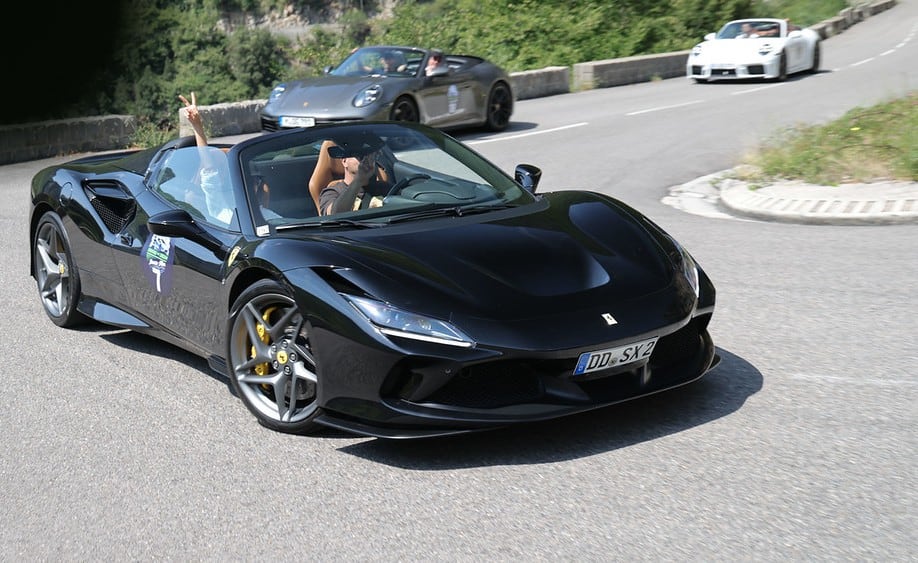
A driving tour is not a road trip with a fancier car. The pacing, the paperwork, and even how you pack all change once the car itself is the point of the trip. Here’s what first-timers on the Porsche Europe route — and on our other two routes — consistently ask about before they go.
1. The route is paced around driving roads, not distance
A 300 km day on an Alpine pass road takes longer — and is far more rewarding — than a 500 km day on a motorway. Good driving-tour itineraries (like the Porsche Europe route through Munich, Tirol, and the Grossglockner) are built around the roads themselves, with generous stops at viewpoints and lunch spots along the way. Don’t judge the day by the kilometer count.
What this means in practice: a day built around the Timmelsjoch high alpine road or the Grossglockner pass will have you covering less ground than a straight motorway run, and that’s by design. These roads reward a slower pace — third-gear corners stacked one after another, viewpoints worth an actual stop rather than a photo through the windscreen, and a lunch break timed around a view rather than a service station. First-time guests sometimes arrive expecting a point-to-point road trip and are surprised the “big” driving day only covers 200 km; by the end of that day, most understand why.
The corollary is that transfer days — the ones connecting two regions rather than showcasing a single pass — do cover more ground, and a good itinerary is honest about the difference. Ask any tour operator for a day-by-day kilometer breakdown before booking; if they can’t give you one, that’s worth noting.
2. Border crossings are a non-event, but bring the right paperwork
Within the Schengen area, crossing from Germany into Austria — or France into Monaco — is usually just a road sign, not a checkpoint. There’s no passport control, no stopping, nothing that interrupts the drive itself. What you actually need is sorted before you ever reach the border, not at it.
Specifically: proof of insurance coverage valid for every country on the route (a “green card” equivalent, or the fleet’s own multi-country policy), and — if you’re driving a rental or fleet car rather than your own — a letter of authorization from the vehicle’s owner confirming you’re permitted to take it across borders. Some countries also require a valid international driving permit alongside your national license, depending on your nationality; it’s worth checking before you travel rather than assuming your regular license covers everything.
Reputable tour operators handle all of this before you arrive, bundled into the fleet paperwork you sign at handover — it’s worth confirming in writing exactly what’s covered rather than taking it on trust. The actual crossing itself, once the paperwork exists, really is as anticlimactic as a road sign.
3. Altitude changes the packing list
The Grossglockner High Alpine Road summits above 2,500 meters. Valley towns along the same day’s route can sit at 25°C while the pass itself is windy and genuinely cool even in the middle of summer — a 15–20°C swing is completely normal on a single day’s drive, sometimes more. Layers, not a single heavy jacket, are the right call.
A practical packing approach: a breathable base layer, a mid layer you can add or remove easily (a fleece or light sweater works better than a bulky jumper you can’t take off in the car), and a wind- and water-resistant outer shell that packs down small enough to keep in the car rather than the hotel room. Gloves are worth packing even in summer if the itinerary includes a high pass — open-top driving at altitude is a different experience from open-top driving at sea level. Sunglasses matter more than you’d expect too; glare off snow patches at altitude, even in July, catches first-timers off guard.
Footwear is the other detail people underestimate. A stiff-soled shoe gives better pedal feel in a high-performance car than the trainers most people default to for travel — not essential, but noticeably better on a technical mountain road.
4. Fuel stops need planning above a certain horsepower
High-performance cars with large tanks and enthusiastic drivers empty a tank faster than the trip computer’s estimate suggests, especially on mountain roads where the engine spends more time working hard than it would on a flat motorway cruise. A car that shows “300 km to empty” on a gentle coastal road can burn through that range noticeably faster once it’s climbing and descending a pass in a spirited manner — and mountain regions don’t always have a fuel station exactly when you’d like one.
A good tour leader plans fuel stops around the route itself — timed to coincide with a viewpoint, a coffee stop, or a town the itinerary passes through anyway — rather than waiting for the warning light and then scrambling to find the nearest station off-route. If you’re planning a self-guided drive rather than a guided tour, build in a wider fuel margin than you would for a normal road trip, particularly in genuinely remote alpine sections where stations can be sparse.
5. The best moments aren’t always at the wheel
Group dinners, hotel terraces looking out over a valley you drove through that afternoon, and comparing notes with other drivers on the trip end up being as memorable as any single stretch of road. Budget time for them, and don’t schedule a driving day so demanding that everyone arrives at dinner too tired to enjoy it.
This is also where a group tour earns its format over a solo road trip: the shared experience of the day — everyone’s version of the same hairpin, the same viewpoint, the same moment the pass finally opened up into a view — becomes conversation in a way that’s hard to replicate driving alone. Guests who’ve done more than one Pure Adrenalin tour consistently mention the evenings as much as the driving when asked what they’d tell a first-timer, and it’s part of why the DRV.club community exists — to keep that overlap going after the trip itself ends.
Curious what a full route looks like in practice? See the Porsche Europe itinerary, the Supercars Rally Monaco for a shorter, coastal alternative, or the Mustangs Tenerife if your calendar points toward winter rather than summer.