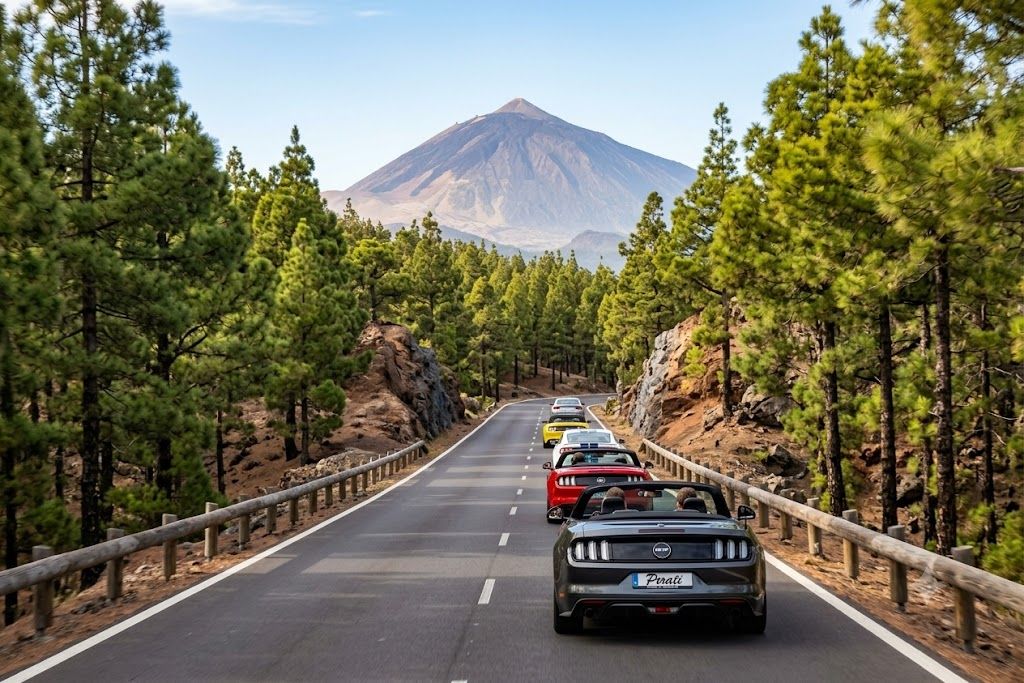
The first thing most people say driving into Teide National Park is that it doesn’t look like the rest of Tenerife, and the second thing they usually say is that it doesn’t look like Earth. Both reactions are correct, and both come down to the same piece of geology.
A caldera, not just a mountain
Teide itself is dramatic enough on its own — at 3,715 meters, it’s Spain’s highest point by a wide margin, and measured from its true base on the Atlantic seafloor rather than sea level, it ranks as the third-tallest volcanic structure on the planet, behind only Mauna Kea and Mauna Loa in Hawaii. But the volcano isn’t what makes the drive through the park feel alien. That’s Las Cañadas — a caldera roughly 16 kilometers across, formed tens of thousands of years ago when an earlier, larger volcanic structure partially collapsed in on itself. What you’re actually driving across on the park’s open plains is the floor of that ancient collapse, ringed by caldera walls that rise as high as 600 meters in places, with Teide itself rising from within it like a second volcano built inside the wreckage of the first.
Why it looks the way it does
The plains themselves are covered in a mix of solidified lava flows, volcanic pumice, and wind-scoured rock in colors that shift from rust-red to near-black to a pale, almost lunar grey depending on the mineral content of a given flow and how long ago it cooled. Almost nothing grows on large stretches of it — the volcanic soil is porous and mineral-poor in a way that keeps most vegetation out, which is exactly why film and TV productions have used the park as a stand-in for other planets for decades; several Mars-set productions have shot here rather than build the landscape artificially. The near-total absence of light pollution at altitude is a related bonus, and Teide’s observatory complex — one of the most important astronomical research sites in the world — takes full advantage of both the clear air and the dark skies above the caldera rim.
Is it actually active?
Yes, technically. Teide’s most recent eruption was in 1909, from a vent called Chinyero rather than the summit crater itself, and the mountain is officially classified as dormant, not extinct — Spain’s national geological institute monitors it continuously, and minor seismic activity is a normal, closely watched occurrence rather than a sign of anything imminent. The volcano’s last truly major eruption is estimated at around 2,000 years ago, which in geological terms is close enough to keep the mountain firmly in the “watched” category rather than the “settled” one.
Driving through it
None of this is background reading you need before the drive — but it’s the reason the TF-38 and TF-28 through the park feel the way they do behind the wheel: open volcanic plains with sightlines that run for kilometers, switchback climbs up through visibly different lava-flow layers stacked on top of each other, and a summit viewpoint that regularly sits above the cloud line looking down at weather happening below you instead of around you. It’s one thing to be told a road runs through a volcanic caldera; it’s a different thing to actually watch the rock color change three times in twenty minutes and realize each shift is a different eruption, centuries or millennia apart, all inside the same fifteen-kilometer stretch of road.
Teide National Park is day 3 of Pure Adrenalin’s Mustangs Tenerife — the driving day built entirely around this landscape. See the full route.