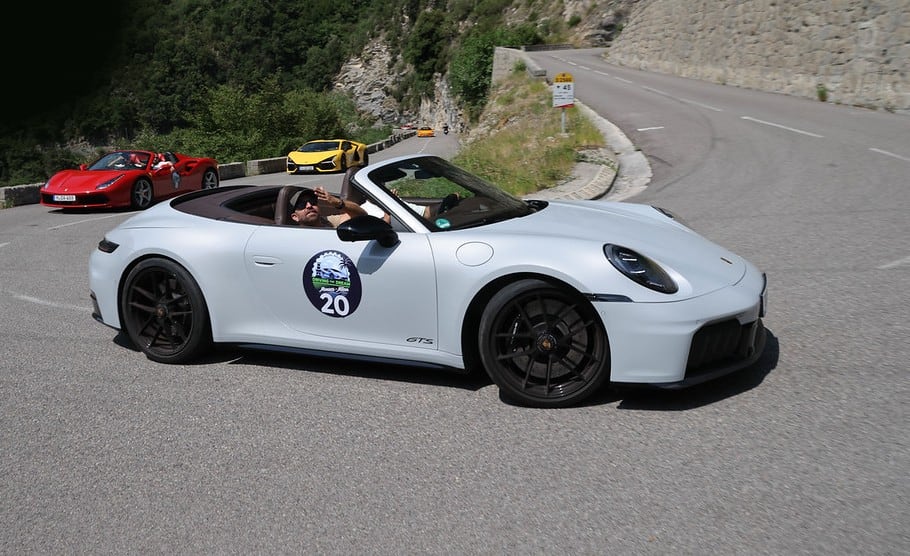
05:40, La Bollène-Vésubie. Still dark. Three engines idling outside a shuttered boulangerie, and not one of them idling quietly. Ron Blazer is already leaning on the 488, arguing with nobody in particular that the newest car is not automatically the best one. Juliana MC2 hasn’t said a word yet — she’s walking a slow circle around the McLaren with the look of someone reading a spec sheet through the bodywork. We’re here to settle it on the actual road, not in a parking lot.
The Col de Turini has been asking drivers this exact question since 1911. It’s the signature stage of the Monte Carlo Rally — the one they used to run at night, in January, on ice, and call La Nuit des Longs Couteaux, the Night of the Long Knives, because that’s what the headlights looked like strobing through the hairpins from across the valley. Roughly thirty corners in the stretch that matters, climbing from the Vésubie river up past 1,600 meters before dropping back down toward the coast. No two corners the same radius. It does not forgive a car that’s wrong for it, and it does not care how much the car costs, or how confident the person behind the wheel is.
Three cars, three drivers, one road. Ron takes the 488 Spider, the car that reintroduced turbocharging to Ferrari’s mid-engine V8 and split opinion doing it — his kind of car before he’s even turned the key. Juliana claims the 750S Spider without discussion, because McLaren’s whole pitch for it is an engineering argument, and that’s the language she thinks in. That leaves the F8 Spider — sharper than the 488 in every measurable way, and, by default, the seat for whoever’s actually running this test.
The numbers, for anyone who wants them before the story
| Ferrari 488 Spider | Ferrari F8 Spider | McLaren 750S Spider | |
|---|---|---|---|
| Seats | 2 | 2 | 2 |
| Engine | 3.9L twin-turbo V8 | 3.9L twin-turbo V8 | 4.0L twin-turbo V8 |
| Horsepower | 670 hp | 720 hp | 750 hp |
| Dry weight | ~1,595 kg | ~1,469 kg | ~1,290 kg |
| 0–100 km/h | 3.0 sec | 2.9 sec | 2.8 sec |
| Top speed | 325 km/h | 340 km/h | 332 km/h |
| Rental (per day) | ~€1,800 | ~€1,800 | ~€2,100 |
| Drivetrain | RWD | RWD | RWD |
Weight figures are manufacturer dry-weight claims, not independently verified this session — treat as indicative rather than exact.
Ron glanced at this table for about two seconds before dismissing it: “None of that tells you what a car feels like at eight-tenths on a road with a wall on one side and a valley on the other.” Juliana didn’t look up from it at all — she’d already found the one row that mattered to her. We’ll get to which one.
First stint: the climb
Ron went up first in the 488, on the theory — his — that you should meet the oldest relative before the loud one arrives. “It’s the only one of the three that still argues with you,” he said over the radio somewhere around the fifth hairpin, and he wasn’t wrong: turbo lag you can actually locate on the tachometer, a wheel that loads up and tells you exactly how much grip is left at the front axle, a V8 note that’s throatier and less digitally perfected than what came after it. Through the string of second- and third-gear corners below the Turini village, it’s a car you have to work, in the way that makes a mountain road interesting instead of just fast. When he finally handed the keys over at the summit, he didn’t want to.
The F8 covered the same stretch about ninety seconds faster and made the 488 feel, briefly, like a museum piece. Same displacement, meaningfully more power, and four extra years of Ferrari sharpening the aerodynamics and electronics instead of just turning up the boost — the car changes direction with noticeably less drama and noticeably more confidence at the same speed. It’s the more complete driving instrument, and, in a way that surprised even the person driving it, slightly less fun in isolation: the F8 does its job so cleanly that some of the 488’s argument with the driver simply isn’t there anymore.
Then Juliana took the McLaren up, and the conversation at the summit changed entirely.
Second stint: the descent, and the argument that matters
“It’s not the horsepower,” Juliana said at the top, before anyone asked. “It’s 300 kilos.” The 750S isn’t just the most powerful car on this road — it’s dramatically the lightest, over 300 kg under the 488 and close to 200 kg under the F8. On a straight, that gap is worth a tenth or two. On thirty consecutive corners with a change of camber in most of them, descending toward Sospel through the tighter, more technical lower section, it’s worth something closer to a different category of car entirely. Less mass to arrest into each apex, more speed carried through it than either Ferrari could match at the same lean angle, power back down earlier out of every hairpin because there’s simply less weight for the rear tires to manage. Juliana came down grinning in a way that undercut every “engineering brief” sentence she’d said all morning.
Ron’s counter, delivered at the bottom with the McLaren’s door still open: “Fastest, sure. But I don’t remember a single thing that car said to me.” That’s the trade the 750S makes — the least characterful engine of the three, effective and urgent but genuinely quieter and more clinical than either Ferrari, a cabin that’s more purely function-first, less occasion. If the 488 is the car Ron would choose to be photographed arriving in and the F8 is the one the rest of us would choose to actually own, the McLaren is the one Juliana would choose if the only thing that mattered today was the stopwatch and the road — and on the Turini, that’s most of what matters.
A bit of context on each car
The 488 Spider matters historically more than it matters on a spec sheet: it was the car that ended Ferrari’s naturally-aspirated V8 era in the mid-engine range, in 2015, and took real criticism at launch for trading throttle response for a torque curve — criticism Ferrari spent the F8’s entire development cycle answering. Driving it now, after the cars that came after it, the “problem” reads more like character, which is exactly Ron’s point.
The F8 Spider is, underneath the redesigned bodywork, closer to an evolved 488 than an all-new car — Ferrari kept the same basic architecture and used what it learned from the 488 Pista to close almost every gap critics had identified. It’s the more rational choice of the two Ferraris in this test by nearly every measure, and the fact that it’s still not the fastest car here says more about how good the McLaren is than it does about any weakness in the F8.
The 750S Spider is McLaren’s direct answer to exactly this kind of test: the brief, publicly stated by McLaren’s own engineers, was less weight and sharper response over the outgoing 720S, not more power for its own sake. Thirty extra horsepower is almost a rounding error next to the diet the rest of the car went on to get here — carbon-fiber bodywork, a lighter exhaust, retuned dampers — and on a road built entirely out of direction changes, that’s exactly the kind of development brief that wins, and exactly the kind of story Juliana came to tell.
Practical considerations
All three are two-seat, RWD, open-top cars with a folding hardtop rather than a soft top — worth knowing if you’re planning to drive the Turini at altitude, where it can be genuinely cold and windy even when the coast fifteen minutes away is warm and still. None carries real luggage space to speak of; this is a road-trip car for two people and an overnight bag, not a family GT. Book with a morning start in mind if you want the road close to empty — by mid-morning in season it fills with a mix of local drivers, cyclists, and other tourists doing exactly what we did.
Our call: the McLaren 750S Spider. On a road defined by corners rather than straights, its weight advantage over both Ferraris is decisive — Juliana’s right, and Ron, by the bottom of the hill, more or less admitted it too. Choose the F8 Spider if you want nearly the same speed with more Ferrari occasion and a genuinely excellent all-rounder, or the 488 Spider if character and a car that talks back to you matter more than lap time — Ron won’t hear a word against it.
Pure Adrenalin’s Supercars Rally Monaco drives this exact road on day 3 of its route, with a guide who knows every hairpin by name — worth considering if six hours on the Turini in one of these leaves you wanting the rest of the coastline too. Renting one of these three on its own for a self-planned weekend out of Monaco or Nice is a completely separate, equally valid option. Get in touch and we’ll set either one up.