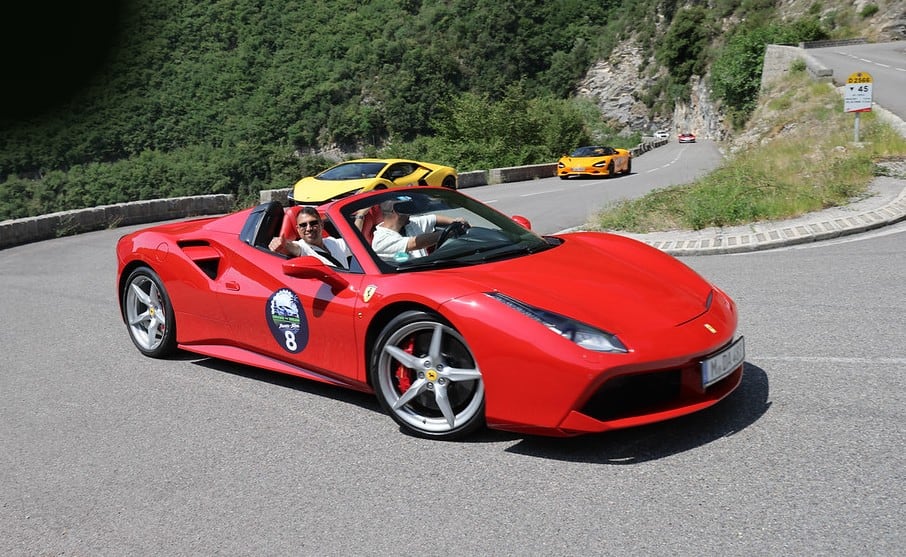
Three roofs went down before anyone said a word about which car was fastest. That, in itself, told you something about what kind of test this was going to be.
A different red than anywhere else on the coast
The Corniche de l’Estérel — officially the N98 — runs along the coast between Saint-Raphaël and Cannes, cut directly through the Massif de l’Estérel, a range of volcanic rock that’s a genuinely different color from anything else on this stretch of the Mediterranean: a deep rust-red rather than the pale limestone of Monaco’s corniches further east. It’s a lower-speed, more relaxed road than Col de Turini or the Grande Corniche — fewer switchbacks, more sweeping curves, and long stretches where the sea is visible almost continuously rather than appearing and vanishing between rock walls. It’s not built to be attacked. It’s built to be enjoyed with the roof down and no particular urgency about getting anywhere.
Three open-top cars for exactly that kind of day. Ron takes the McLaren 720S Spider, the lightest and fastest of the three on paper. Juliana claims the Lamborghini Huracán EVO Spider for the naturally aspirated V10 — no turbo lag to manage, nothing to smooth over, just a direct throttle she’s been chasing since Grossglockner. The Ferrari 296 GTS goes to whoever’s running the test.
The numbers, for anyone who wants them before the story
| Ferrari 296 GTS | McLaren 720S Spider | Lamborghini Huracán EVO Spider | |
|---|---|---|---|
| Seats | 2 | 2 | 2 |
| Engine | 3.0L twin-turbo V6 PHEV | 4.0L twin-turbo V8 | 5.2L NA V10 |
| Horsepower | 819 hp combined | 720 hp | 640 hp |
| 0–100 km/h | 2.9 sec | 2.9 sec | 3.1 sec |
| Top speed | 330 km/h | 341 km/h | 325 km/h |
| Roof down, under | ~14 sec | ~11 sec | ~17 sec |
| Rental (per day) | ~€1,800 | ~€2,100 | ~€1,950 |
| Drivetrain | RWD | RWD | RWD |
Roof-operation timings are manufacturer-published figures, not independently verified this session — treat as indicative rather than exact.
Ron went straight for the top speed row, same as always. Juliana went straight for the engine column. Neither of them ended up being the row that decided the day.
First stretch: heading toward Cannes
Ron opened the 720S up on the first long sweeping section past Anthéor, and on a road with room to actually use the numbers, it did exactly what the spec sheet promised — quickest roof, lightest car, most eager to build speed on anything resembling a straight. For about twenty minutes, this looked like the easiest verdict of any road test we’ve run.
Then the road narrowed, slowed, and started doing what the Corniche de l’Estérel actually spends most of its length doing: winding gently along a coastline that rewards looking at it more than driving through it fast. Juliana’s Huracán EVO came alive here in a way the spec sheet doesn’t capture — that naturally aspirated V10 doesn’t need revs to sound spectacular, and at the kind of unhurried pace this road actually calls for, it’s simply the best-sounding car of the three, turbo lag never entering the conversation because there’s no turbo to lag.
Second stretch: the argument that actually mattered
The 296 GTS came last, and it did something neither of the other two managed: it made the case that the right car for this specific road isn’t the fastest one or the loudest one, but the one that’s genuinely comfortable to be in for two unhurried hours with the roof down and the radio off. The hybrid V6 note is more restrained than the Huracán’s V10 but far from characterless, the ride quality handles the coast road’s occasional rough patches without punishing anyone in the cabin, and — the detail that actually swung it — it was the only one of the three where a two-hour coastal cruise didn’t leave the driver’s ears ringing by Cannes.
“I still think the 720S is the better car on paper,” Ron said, pulling up at the final stop. “I just don’t think ‘better on paper’ was ever what this road was asking for.” Juliana’s counter was quieter than usual: “The V10 was the most fun for maybe forty minutes. The Ferrari was the one I’d actually want for the whole two hours.”
A bit of context on each car
The Ferrari 296 GTS is the open-top sibling to the 296 GTB — see Juliana’s full spotlight on the hybrid V6 architecture that makes both versions work the way they do — with a retractable hardtop rather than a soft top, adding some weight over the coupe but changing very little about how the car actually drives.
The McLaren 720S Spider shares its underlying carbon-fiber tub with the coupe, engineered specifically so removing the roof costs almost nothing in structural rigidity or added weight — a genuinely rare achievement in the convertible-supercar segment, where roof removal usually comes with real compromises.
The Lamborghini Huracán EVO Spider carries the same naturally aspirated V10 as its hardtop sibling, and remains one of the last open-top exotics on the market without any form of turbocharging or hybrid assistance — a genuinely different driving character from almost everything else currently in the fleet.
Practical considerations
All three handle wind buffeting reasonably well at coastal-road speeds with the roof down, though a wind deflector (available for all three on request) makes a noticeable difference on longer stretches. The Corniche de l’Estérel gets busy with cyclists and tourist traffic in peak summer afternoons — an early morning or early evening run avoids most of it. All three cars are available out of the French Riviera and Monaco.
Our call: the Ferrari 296 GTS. On a road built for enjoying the drive rather than attacking it, the balance between engine character and everyday comfort wins over either rival’s outright numbers. Choose the McLaren 720S Spider if outright speed and the fastest roof matter most, or the Huracán EVO Spider if you want the last naturally aspirated V10 experience with the top down.
All three are standalone rentals — a separate booking from the Supercars Rally Monaco, which drives a different stretch of this same coastline. Get in touch and we’ll set one up.