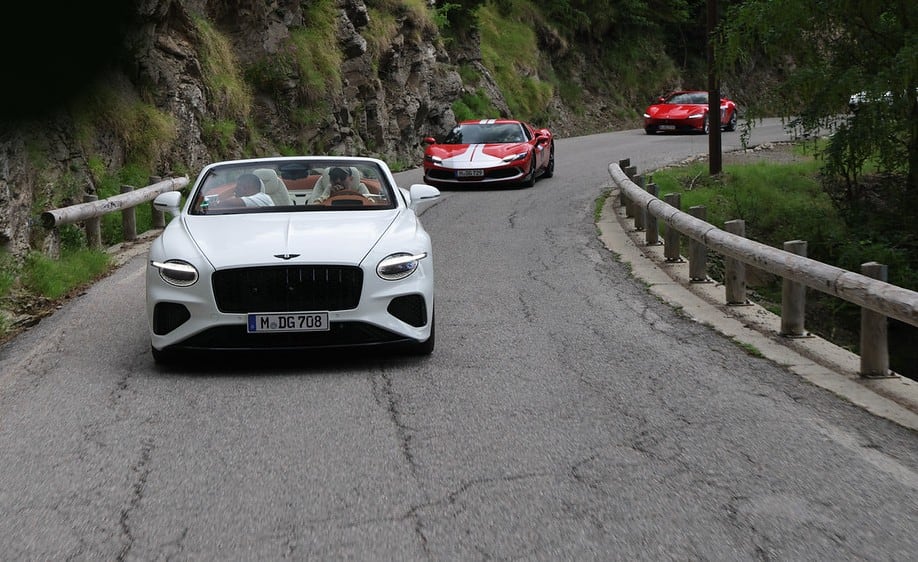
Juliana picked the 296 GTB before Ron had finished reading the spec sheet out loud. “It’s the only one with an electric motor filling the torque gap,” she said. “I already know what that does on a mountain exit.” Ron, still holding out for the McLaren’s numbers, wasn’t ready to concede anything yet.
Austria’s highest paved road
The Grossglockner High Alpine Road climbs to 2,571 meters at its highest publicly accessible point, the Edelweissspitze viewpoint — a toll road built in the 1930s specifically as a piece of engineered tourism infrastructure, and one of the most-visited paid mountain roads in Europe as a result. It shares the same general Alpine region the Porsche Europe route passes through on its way between Munich and Tirol, but the road itself is a standalone destination: a continuous sequence of switchbacks climbing well above the treeline, with sightlines across multiple mountain ranges on a clear day and genuinely unpredictable weather that can shift from clear sun to low cloud within a single climb.
Three cars that, on paper, should have made this an almost pointless comparison. Ron takes the McLaren 720S for its outright numbers. Juliana claims the Ferrari 296 GTB for a reason that has nothing to do with any number on the spec sheet. The Lamborghini Huracán EVO Spider — driven roof-up for this test, given the altitude — goes to whoever’s running the day.
The numbers, for anyone who wants them before the story
| Ferrari 296 GTB | McLaren 720S | Lamborghini Huracán EVO | |
|---|---|---|---|
| Seats | 2 | 2 | 2 |
| Engine | 3.0L twin-turbo V6 PHEV | 4.0L twin-turbo V8 | 5.2L NA V10 |
| Horsepower | 819 hp combined | 720 hp | 640 hp |
| Dry weight | ~1,470 kg | ~1,283 kg | ~1,543 kg |
| 0–100 km/h | 2.9 sec | 2.9 sec | 3.1 sec |
| Top speed | 330 km/h | 341 km/h | 325 km/h |
| Rental (per day) | ~€1,900 | ~€2,100 | ~€1,950 |
| Drivetrain | RWD | RWD | RWD |
Weight figures are manufacturer-published dry-weight claims, not independently verified this session — treat as indicative rather than exact.
Ron’s first read of the table: “720S is lightest, fastest top speed, and it’s not even close on the stopwatch to either of these.” Juliana’s read was different — she wasn’t looking at the 0-100 row at all.
First stint: the climb to Edelweissspitze
Ron went up first in the 720S, and for the lower, more open sections of the climb, the McLaren’s numbers translated exactly the way you’d expect: lightest car here by a wide margin, sharpest turn-in, a naturally aspirated-feeling throttle response that belies the twin turbos entirely. “This is what ‘lightest car wins’ looks like when the numbers actually hold up,” Ron radioed down, sounding entirely too pleased with himself for someone who hadn’t finished the climb yet.
Juliana went up next in the 296 GTB, and the tighter, more switchback-dense upper section of the road told a different story. The hybrid electric motor’s job is specifically to fill the torque gap that exists while a turbo engine is still spooling — and on a road built almost entirely from low-speed hairpin exits, that gap-filling happens dozens of times over a single climb. Where the 720S needs a beat to build boost out of the tightest corners, the 296 GTB is already pulling, electric assist doing the work until the turbos properly catch up. “It’s not that the McLaren is slow out of these corners,” Juliana said. “It’s that the Ferrari never has a gap to begin with.”
Second stint: the descent, and where the numbers stopped mattering
The Huracán EVO came down last, roof up against the altitude chill, and made its own case in the process — the naturally aspirated V10 is the only genuinely analog engine of the three, no turbo lag to manage in either direction, no electric motor smoothing anything over, just a direct, linear relationship between right foot and rear tires that both other drivers admitted they’d missed a little by that point in the day. It wasn’t the fastest car down the mountain. It was, by a comfortable margin, the one that made the descent sound the best.
By the bottom, Ron had come around, mostly. “I still think the 720S is the more complete car,” he said. “I just can’t argue with what Juliana’s describing about the exits.” Juliana didn’t need to say anything else — she’d made her case with the stopwatch numbers already on the table before the day even started.
A bit of context on each car
The Ferrari 296 GTB is Ferrari’s smallest current engine producing one of its most complete road-going cars — see Juliana’s full spotlight on exactly why the hybrid V6 architecture works the way it does.
The McLaren 720S remains, years after launch, one of the lightest cars in this power class — its carbon-fiber Monocage II chassis was engineered specifically to minimize weight at the expense of almost nothing else, and it’s part of why the car still competes with newer, more powerful rivals on a road like this.
The Lamborghini Huracán EVO is the last Huracán generation to run a naturally aspirated V10 without any hybrid assistance at all — a genuine end-of-an-era engine in Lamborghini’s own lineup, and increasingly the reason people specifically request it over its newer, more powerful hybrid stablemates.
Practical considerations
All three are two-seat, low-slung cars, and the Grossglockner’s altitude brings real temperature swings — pack for a 15-20°C drop between the base and the Edelweissspitze summit even in summer. The road is a toll road with a modest per-vehicle fee, and it can close in poor weather or heavy snow outside the main season, so check conditions before planning a self-drive visit. All three cars are available out of Munich, making a Grossglockner day trip a realistic addition to a Porsche Europe-adjacent booking.
Our call: the Ferrari 296 GTB. On a road built from dozens of low-speed hairpin exits, the hybrid’s torque-fill advantage adds up in a way the stopwatch numbers alone don’t predict — Juliana’s right. Choose the McLaren 720S if outright lightness and top-end speed matter most, or the Huracán EVO if you want the last naturally aspirated V10 experience before this generation disappears from the lineup entirely.
All three are standalone rentals out of Munich — a separate booking from the Porsche Europe Road Trip, which passes through this same general Alpine region if a Grossglockner detour of your own sounds appealing. Get in touch and we’ll set one up.