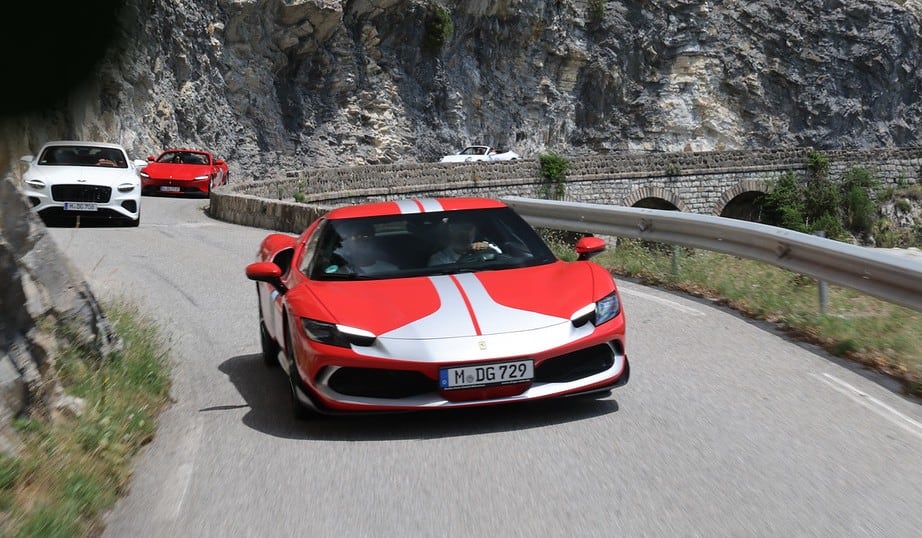
Ron wanted the SF90 before Juliana had even opened the McLaren’s door. “Give me the one with the biggest number on the spec sheet,” he said, which is not usually how Ron picks a car, and he knew it. Juliana didn’t argue — she’d already decided the Artura was the interesting story here, for reasons that had nothing to do with which number was biggest.
Forty-eight hairpins, numbered
The Stelvio Pass’s eastern ascent, from the village of Prato allo Stelvio, is famous for one specific detail: every hairpin is numbered, in descending order, counting down from 48 as you climb toward the 2,758-meter summit. It’s a strange psychological trick — most mountain passes give you no sense of how much climbing is left, but here you know exactly how many switchbacks remain at any given moment, which somehow makes both the fatigue and the anticipation worse. The road was originally built in the early 20th century, and it climbs with a relentlessness that modern alpine engineering rarely bothers with anymore — nobody flattens a gradient here, they just build another hairpin.
Three drivers, three hybrid hypercars, one road that refuses to let any of them stretch their legs in a straight line. Ron takes the Ferrari SF90 Spider for the number on its spec sheet. Juliana claims the McLaren Artura, the least powerful of the three by a wide margin, because she’s already done the math on what a lighter hybrid does on 48 consecutive hairpins. The Lamborghini Revuelto goes to whoever’s running the test — the most powerful car of the three, and, on paper, the least likely underdog.
The numbers, for anyone who wants them before the story
| Ferrari SF90 Spider | Lamborghini Revuelto | McLaren Artura | |
|---|---|---|---|
| Seats | 2 | 2 | 2 |
| Engine | 4.0L twin-turbo V8 PHEV | 6.5L NA V12 PHEV | 3.0L twin-turbo V6 PHEV |
| Horsepower | 1,000 hp combined | 1,015 hp combined | 700 hp combined |
| Dry weight | ~1,670 kg | ~1,772 kg | ~1,498 kg |
| 0–100 km/h | 2.5 sec | 2.5 sec | 3.0 sec |
| Top speed | 340 km/h | 350 km/h | 330 km/h |
| Rental (per day) | ~€2,200 | ~€2,000 | ~€2,100 |
| Drivetrain | AWD | AWD | RWD |
Weight figures are manufacturer-published dry-weight claims, not independently verified this session — treat as indicative rather than exact.
Ron’s reaction to the table: “1,015 horsepower and a V12 that’s still naturally aspirated under all the electric assistance. Case closed.” Juliana’s reaction was to point at a single number nobody else had mentioned yet — the 274-kilogram gap between the Artura and the Revuelto.
First stint: the climb from hairpin 48
Ron went up first in the SF90, and for the first dozen numbered hairpins, his argument looked unbeatable. All-wheel drive puts every one of those 1,000 horsepower down cleanly out of a tight, low-speed switchback in a way a rear-drive car simply can’t match, and the SF90 rockets between corners with a kind of contemptuous ease — this is a car that makes 48 hairpins feel like considerably fewer. “Genuinely can’t imagine wanting more power than this on a public road,” Ron said over the radio around hairpin 30, and at that point in the climb, nobody was inclined to argue.
Juliana went up next in the Artura, and the story of the day changed almost immediately. Down nearly 300 combined horsepower against the SF90, on paper the Artura should have been the slow car of the group. It wasn’t. Through the tightest, lowest-speed hairpins — exactly the kind Stelvio has 48 of — the weight advantage did precisely what Juliana predicted: less mass to rotate into each switchback, a chassis that changes direction with none of the inertia the two heavier cars are fighting, and a rear-drive setup that, on a road this technical, turned out to be an advantage rather than the disadvantage it looks like on a spec sheet against two AWD rivals.
Second stint: the descent, and the argument that settled it
The Revuelto went last, on the descent, and it split the difference in the most literal way possible — more power than the Artura, less weight-related agility than either extreme, a V12 soundtrack that made every one of the lower hairpins into a genuine occasion regardless of who was winning the actual argument. “This is the one I’d want to be seen arriving in,” the narrator radioed down, which is a different compliment than “this is the one that won,” and everyone on the descent understood the distinction.
By the bottom, even Ron had come around. “It’s not that the SF90 is slow anywhere,” he said. “It’s that the Artura never once felt like it was working to keep up.” Juliana didn’t gloat about it — she just pulled up the weight figures on her phone again, which by that point felt less like a flex and more like she’d been right the whole time and was simply confirming it.
A bit of context on each car
The Ferrari SF90 Spider remains the most outright powerful hybrid Ferrari currently in the fleet, and its all-wheel-drive system — unusual for a mid-engine Ferrari — exists specifically to put a four-figure horsepower number down without spinning the rear tires into oblivion out of every corner. It’s the car built to answer “what’s the biggest number,” and on that question, it’s very hard to argue with.
The Lamborghini Revuelto is the V12 hybrid flagship that replaced the Aventador, and it’s worth noting what Lamborghini chose not to compromise on: even with a full plug-in hybrid system bolted on, the V12 itself remains naturally aspirated, which is increasingly rare in this segment and is a meaningful part of why it sounds the way it does at high revs.
The McLaren Artura was, from its original development brief, McLaren’s first series-production hybrid — and the engineering priority from day one was minimizing weight penalty from the battery and motor rather than maximizing combined output. Today’s road proved that philosophy has real, measurable consequences on exactly the kind of technical mountain pass it was designed to answer for.
Practical considerations
All three are two-seat, low-slung cars with minimal ground clearance — worth knowing before a Stelvio run, since the pass’s surface, while well maintained, isn’t always billiard-smooth after a hard Alpine winter. None of the three carries meaningful luggage space; this is strictly a day-drive car, not a touring companion. All three are available out of Munich, Nice, Monaco, and Paris, making a Stelvio day trip a realistic add-on to a Munich-based booking given the drive is roughly three to four hours each way.
Our call: the McLaren Artura. On a pass built entirely from 48 consecutive low-speed hairpins, the weight advantage is decisive in a way no amount of extra horsepower from the other two can fully answer — Juliana’s right. Choose the Ferrari SF90 Spider if outright power and all-weather AWD security matter most, or the Lamborghini Revuelto if you want the V12 occasion and don’t mind giving up a little agility for it.
All three are standalone rentals — a separate booking from any Pure Adrenalin tour, though the Porsche Europe Road Trip passes through this same general stretch of the Alps if a Stelvio detour of your own sounds appealing. Get in touch and we’ll set one up.