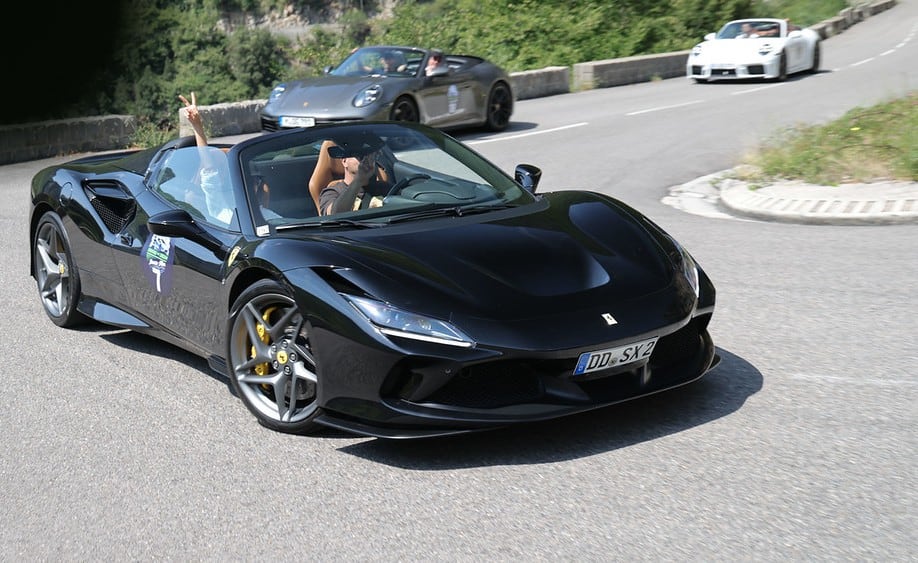
Three AWD cars, one road that used to be crossed on foot by smugglers rather than driven by anyone in a hurry. Ron picked the Turbo S before Juliana finished her sentence about the 992’s chassis balance — a rare case of him going for the “safest” car rather than the loudest one, and he had a specific reason for it.
A smugglers’ road, now a museum
Timmelsjoch sits on the border between Austria and Italy at just over 2,500 meters, and for centuries before it was ever paved, it was crossed on foot by people moving goods between the two countries without much interest in doing it legally. The modern road, when it was finally built, kept the character of that history rather than sanding it down — genuinely unpredictable weather even in summer, blind curves without the generous sightlines of a road built purely for tourism, and a small architectural museum at the summit, the Timmelsjoch Experience, marking the crossing itself as a destination rather than just a pass-through point.
Three drivers, three AWD German performance cars — a deliberate theme, since a road this unpredictable makes the case for all-wheel drive better than any spec sheet argument could. Ron takes the Porsche 911 Turbo S. Juliana claims the 992 Carrera 4 GTS, the more balanced, less brute-force car of the two Porsches. The Audi R8 V10 goes to whoever’s running the test — the odd one out, mid-engine rather than rear-engine, and the only naturally aspirated engine of the three.
The numbers, for anyone who wants them before the story
| Porsche 911 Turbo S | Porsche 992 Carrera 4 GTS | Audi R8 V10 | |
|---|---|---|---|
| Seats | 4 | 4 | 2 |
| Engine | 3.7L twin-turbo flat-6 | 3.0L twin-turbo flat-6 | 5.2L NA V10 |
| Horsepower | 650 hp | 480 hp | 562 hp |
| 0–100 km/h | 2.7 sec | 3.3 sec | 3.4 sec |
| Top speed | 330 km/h | 312 km/h | 324 km/h |
| Rental (per day) | ~€1,100 | ~€1,800 | ~€800 |
| Drivetrain | AWD | AWD | AWD |
Ron’s read of the table was immediate: “170 more horsepower, and it’s the only one with actual launch control built for a road you can’t see around.” Juliana’s counter was quieter — she’d already decided the GTS’s lower weight and more balanced chassis mattered more up here than raw output.
First stint: the climb from the Ötztal side
The R8 went up first, and the naturally aspirated V10 immediately made its case in the least turbocharged way possible: a throttle response with zero lag in either direction, an engine note that climbs in pitch exactly as fast as the tachometer does, and a mid-engine chassis that turns in with a directness neither Porsche quite matches. Through the lower switchbacks it felt, if anything, like the most alive car of the three — right up until the weather did what Timmelsjoch weather does.
Juliana’s GTS came up next, into cloud that had rolled in without much warning, visibility dropping to a fraction of what it had been twenty minutes earlier. This is exactly the scenario the GTS’s more balanced AWD system and lighter overall weight are built for — precise, confidence-inspiring, the kind of car that lets a driver keep a measured pace in poor visibility without the front end ever feeling uncertain. “This is the smart choice,” Juliana said over the radio. “Not the fastest. The one that doesn’t ask you to gamble.”
Second stint: the descent, and the argument that actually mattered
Ron took the Turbo S down through the same deteriorating conditions, and made a case that was hard to argue with by the bottom: 650 hp and Porsche’s most sophisticated AWD system don’t just mean faster, they mean more margin — the same visibility, the same unpredictable surface, but noticeably more confidence in reserve if a curve tightened up more than expected. “It’s not about using the power,” Ron said. “It’s about having it there and not needing to think about whether the car can handle what the road’s about to do.”
By the bottom, Juliana’s counter had softened. “The GTS is still the more rewarding car to actually drive well,” she said. “But if the only thing that mattered today was getting down safely in changing weather, Ron’s right about which one you’d want.” That’s a different kind of verdict than most of our road tests land on — not the most exciting car, but the one that removes the most uncertainty on a genuinely unpredictable road.
A bit of context on each car
The Porsche 911 Turbo S sits at the top of the current 911 range specifically for scenarios like this — see the full spotlight on why usable AWD confidence, not just outright numbers, is the actual selling point.
The 992 Carrera 4 GTS occupies the sweet spot in Porsche’s own lineup between the standard Carrera and the Turbo S — full AWD without the Turbo S’s outright power ceiling, tuned for balance rather than outright numbers.
The Audi R8 V10 remains one of the last naturally aspirated V10s available as a rental anywhere in this fleet, mid-engine rather than rear-engine like the two Porsches, and increasingly a car people specifically request for exactly that reason as turbocharged and hybrid powertrains take over the rest of the segment.
Practical considerations
Timmelsjoch is a toll road, seasonal — typically open only in the warmer months and closed by snow the rest of the year, so confirm current conditions before planning a self-drive visit. Weather genuinely changes fast at this altitude; all three cars’ AWD systems are a meaningful safety margin here, not just a performance statistic. All three are available out of Munich.
Our call: the Porsche 911 Turbo S. On a road this unpredictable, margin matters more than outright thrill — Ron’s right, and it’s the closest thing to a consensus verdict any of our tests have landed on. Choose the 992 Carrera 4 GTS if you want more balance and less brute force, or the R8 V10 if a naturally aspirated V10 outweighs everything else on your list.
All three are standalone rentals out of Munich — a separate booking from the Porsche Europe Road Trip, which drives this exact pass as part of its route. Get in touch and we’ll set one up.