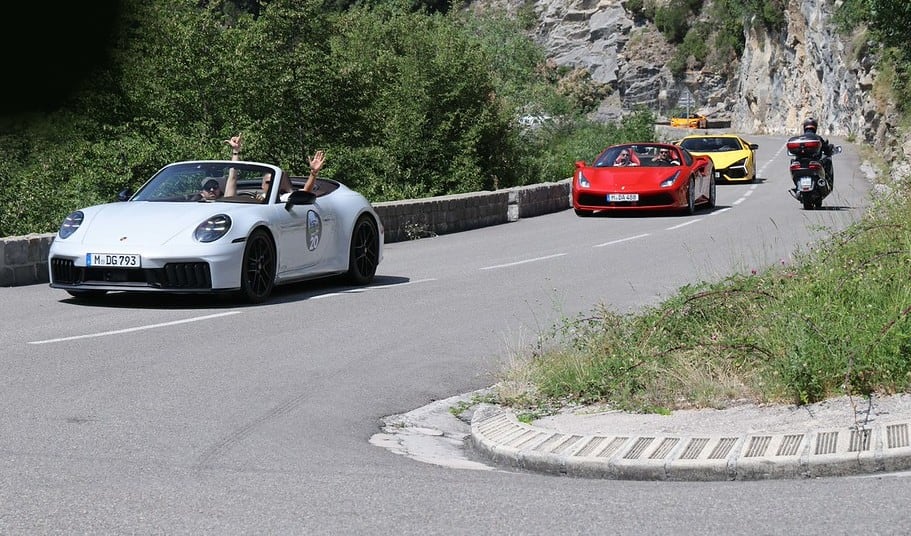
Three McLarens, one brand arguing with itself. Ron picked the 750S Spider out of loyalty as much as anything, and by the end of the day even he admitted the Artura had done something genuinely surprising.
Back to the mountain that rewards precision
This is the second test in this series to run on the Cime de la Bonette, and the choice is deliberate: a relentless sequence of hairpins with almost no flat sections to recover on is exactly the road to expose the real difference between a hybrid throttle response and a pure-combustion one, rather than letting outright horsepower numbers do all the talking.
Three drivers, three points in McLaren’s own recent history. Juliana takes the McLaren Artura, the brand’s first series-production hybrid, and argues that a genuinely different engineering approach deserves to be judged on its own terms rather than as “the McLaren with a battery.” Ron claims the McLaren 750S Spider — the newest pure-combustion car in the range, and the one he’s already made a case for winning outright at Col de Turini. The McLaren 720S goes to whoever’s narrating: the coupe that came before either of them, and the baseline both newer cars are ultimately measured against.
The numbers, for anyone who wants them before the story
| McLaren 720S | McLaren Artura | McLaren 750S Spider | |
|---|---|---|---|
| Seats | 2 | 2 | 2 |
| Engine | 4.0L twin-turbo V8 | 3.0L V6 plug-in hybrid | 4.0L twin-turbo V8 |
| Horsepower | 720 hp | 700 hp | 750 hp |
| 0–100 km/h | 2.9 sec | 3.0 sec | 2.8 sec |
| Top speed | 341 km/h | 330 km/h | 332 km/h |
| Rental (per day) | ~€2,100 | ~€2,100 | ~€2,100 |
| Drivetrain | RWD | RWD | RWD |
All three figures come straight from this fleet’s own listing — a genuinely clean, all-McLaren comparison, no hedging required. Worth noting: the Artura has the lowest horsepower figure of the three on paper, which makes what happened on the mountain more interesting, not less.
First stint: the lower hairpins, where the 720S set the baseline
The 720S went up first, and made the case for what a pure twin-turbo V8 without hybrid assistance has always done well: predictable, linear power delivery once boost builds, a chassis that’s been proven across years of real-world driving. “This is still a genuinely excellent car,” the narrator said. “It’s just not the newest idea McLaren has had.”
Ron’s 750S Spider followed, sharper and thirty kilograms lighter than the 720S it replaced, and made the emotional case he’s made before in this series. “This is still the one I’d want,” he said. “It’s everything the 720S is, refined.”
Second stint: the upper hairpins, and the response that changed the verdict
The Artura came up last, into the tightest, most relentless section of the climb, and Juliana’s case stopped being theoretical the moment the hairpins came one after another with no room to recover between them. The hybrid system’s electric motor fills in exactly where a purely combustion engine still has a fraction of lag waiting for boost — and on a road with corner after corner rather than long straights to build speed, that fraction of a second, repeated dozens of times, added up to something both other drivers noticed immediately. “It’s not about the horsepower number,” Juliana said. “It’s that the power is just there, every single time, before either of these two combustion engines have finished thinking about it.” Even Ron, by his own account, hadn’t expected the gap to be this obvious.
A bit of context on each car
The McLaren 720S remains a genuinely excellent pure-combustion supercar, and the baseline this entire test measured everything else against.
The McLaren Artura is McLaren’s first series-production hybrid — see the full apex-hunting test for how it performed against very different rivals on this same road.
The McLaren 750S Spider already won its own test outright — read the Col de Turini road test and the full spotlight for the case Ron makes for it elsewhere.
Practical considerations
The Cime de la Bonette is a seasonal high-alpine road, typically closed by snow outside the warmer months — confirm current conditions before planning a visit. All three cars are confirmed available out of Monaco, the French Riviera, Munich, and Paris.
Our call: the McLaren Artura. Juliana’s pick wins on response, not raw horsepower — the hybrid system’s instant torque-fill genuinely outperformed both pure-combustion McLarens on a road built entirely out of corners. Choose the McLaren 750S Spider if the emotional case and open-top drama matter more than outright responsiveness, or the McLaren 720S if a proven, pure-combustion platform is what you actually want.
All three are standalone rentals out of Monaco, the French Riviera, Munich, and Paris. Get in touch and we’ll set one up.